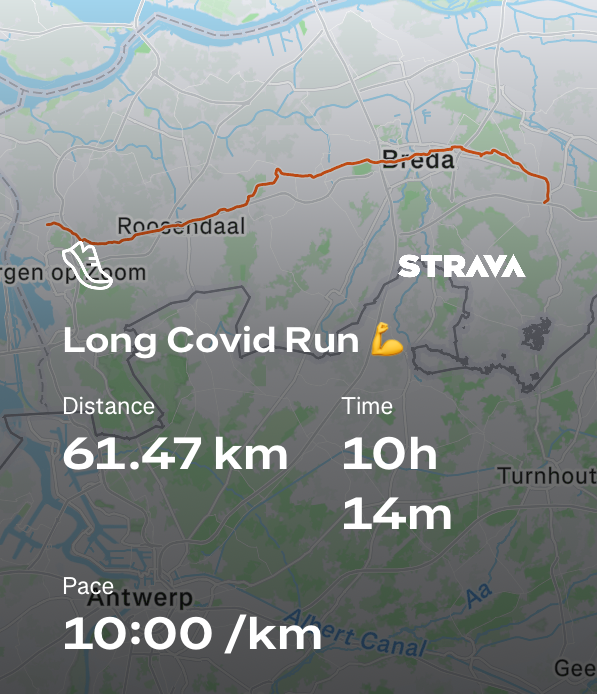
I made it: 61.5 kilometers in 10 hours and 14 minutes. 😅
That number still feels a bit surreal when I write it down. My average pace was 10:00 min/km, including a few stops to refill water and some stretches of walking. All in all, I was running for about nine hours, walked for more than half an hour, and somewhere along the way passed 80,000 steps. You can see the whole thing on my Strava activity (and more of my running on my Strava profile).
But this run was never really about the distance. I ran from the place where the first confirmed COVID-19 case in the Netherlands was identified in February 2020 to my brother's home in Halsteren. My brother has been living with Long Covid since March 2021. For many people, the pandemic feels like something safely in the past. For him — and for a lot of others — it is still very much part of daily life.
More on that further down. First, let me tell you how I got there. Because if there's one thing this run taught me, it's that you can prepare for almost everything, except the exact moment you're actually in.
Preparation: when a marathon becomes "just" a training run
A few weeks before the big day, I caught myself thinking something that would have sounded absurd to me a few years ago: since when did a marathon become a training run? 😅
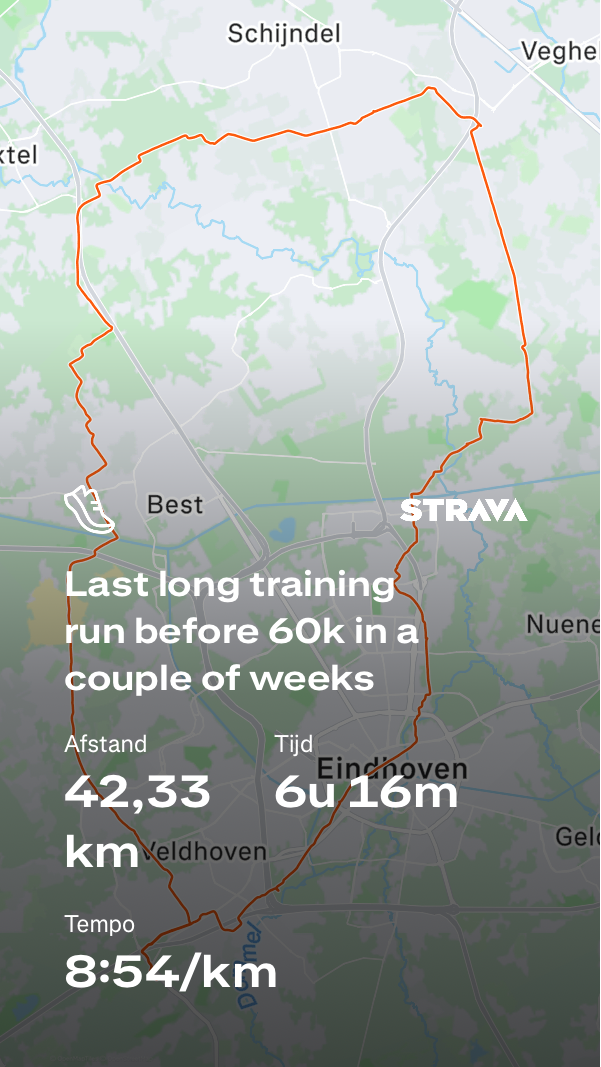
That thought showed up somewhere around the 30th kilometer of a 42 km run. It wasn't a race. It was "just" a long training run — the peak of my build-up toward the 60 km. It still feels strange to call a full marathon a preparation run, but that's exactly what it was: the last big block of work before the real thing.
I've written before about finding your pace and going slow to go far, and this build-up was the long-game version of that idea. You don't show up at the start of a 60 km run and improvise. You build toward it, week by week, distance by distance, until the body trusts that the distance is survivable.
Fueling and hydration: the part nobody sees
If the running is the visible part, the fueling is the invisible part — and it's where a surprising amount of the work happens.
For weeks, I had been planning and training my nutrition and hydration: what to eat before, which gels to take and when, how much to drink, how my stomach handled all of it under load. Fueling for ten hours of effort is its own discipline. Take in too little and you fall apart; take in too much, or the wrong thing, and your gut rebels.
I even built the route itself around hydration. Rather than carrying everything or hoping for the best, I planned the course based on the public water points I knew I could reach along the way — places to refill so I wouldn't run dry over such a long distance. It felt clever. It was clever. And it still didn't go to plan.
Race day: the plan meets reality
The first part went well. Maybe too well — in hindsight, I started a bit too fast, "fast" being a very relative term here. 😉 I knew this would happen. I had told myself, again, that the hard part would be taking it easy in the first 20 to 30 kilometers. And, again, I fell straight into that trap.
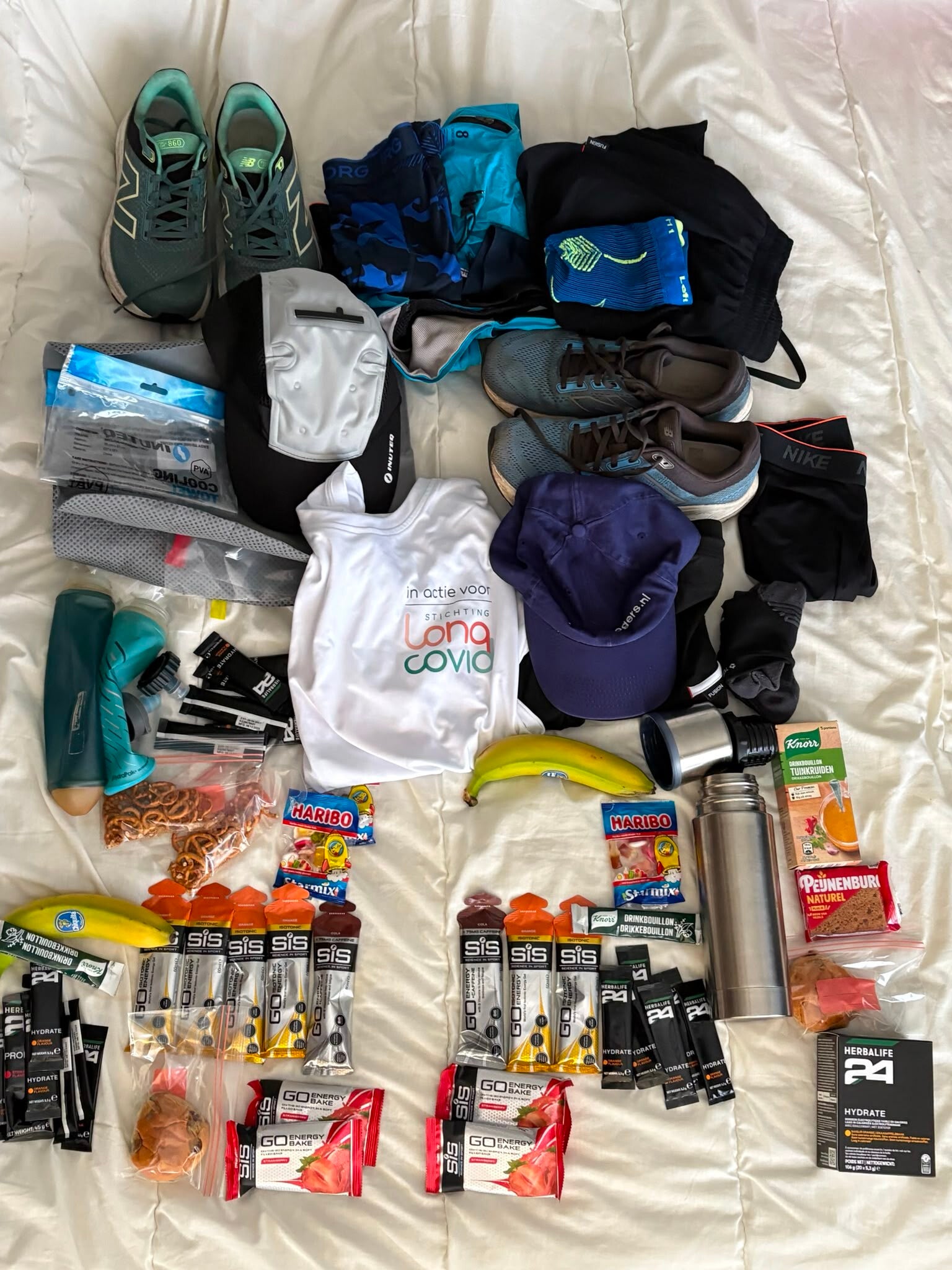
Around 25 km, I noticed my heart rate creeping up, partly because my stomach started to act up — despite all that careful fueling preparation. I managed to get it back under control, but my stomach never really settled after that. So much for the perfect plan.


And this is also where part of the lesson lies. Preparation gets you to the start line. Adaptation gets you to the finish. All those weeks of fueling work didn't fail me because they "didn't work." They worked precisely because, when things went sideways, I had enough margin and enough practice to adjust — to slow down, to walk when I needed to, to refill at the points I'd mapped, and to keep moving forward instead of stopping.
That, to me, is what resilience actually looks like up close. Not gritting your teeth and forcing the original plan. Just refusing to quit on the goal while staying flexible about the route to it.
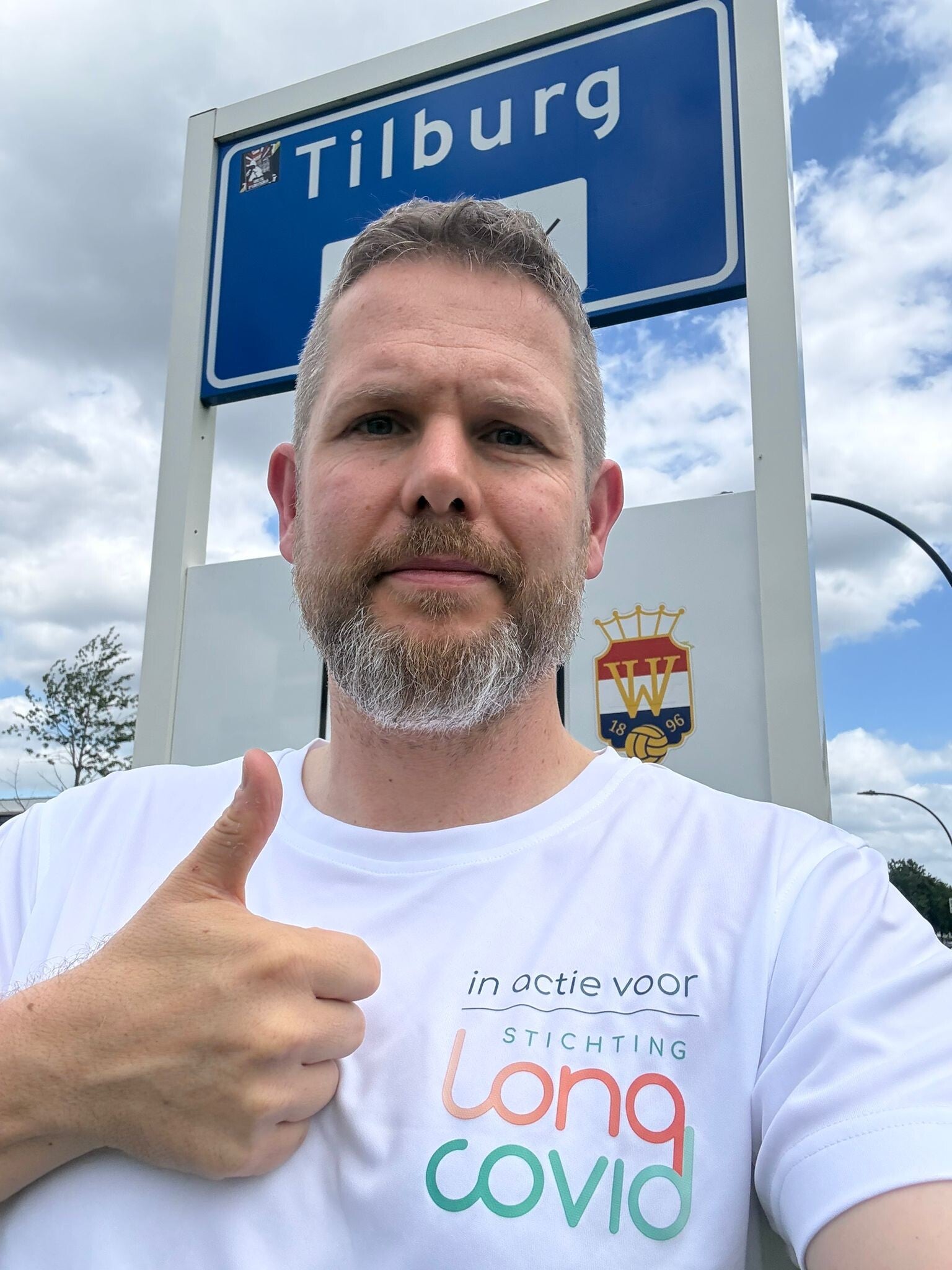
Watching those place names go by, one after another, was its own kind of motivation. Each sign meant another piece of the route behind me, and another step closer to my brother's front door.
The support that carried me
I made it to the end. 🚀 And a huge part of that was the support along the way.
Messages from friends popped up on my phone exactly when I needed them. My family showed up at different points on the route. And in the final stretch, my mother cycled alongside me. ❤️ After hours alone with my own legs and my own doubts, having someone there — physically there — made a real difference.
It reminded me of something I've felt in every long solo effort I've done: the distance is something only you can cover, but you almost never cover it entirely alone.
Why I really ran
So, back to the reason any of this happened.
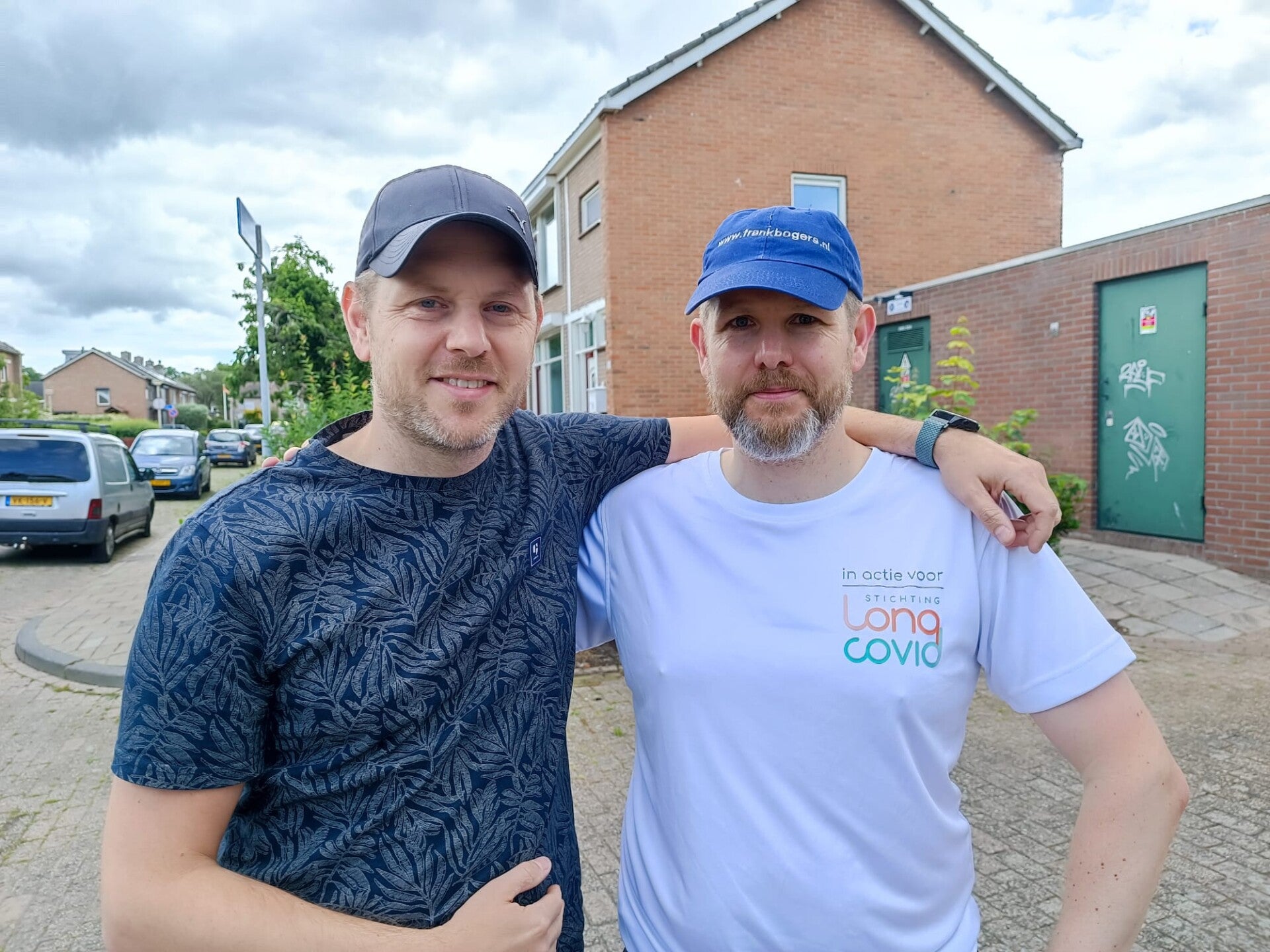
I ran from the place of that first Dutch COVID case to my brother's home because he has been living with Long Covid since March 2021. Long Covid is often a hidden illness — not because its impact is small, but because so much of it happens out of sight. People are exhausted, limited, isolated, often unable to take part in work, family life, sport, or society the way they once did.
That contrast is exactly why I wanted to run from a symbolic beginning of the pandemic all the way to where my brother lives his daily reality now. From the first case to a daily fight.
The fundraiser is still open
I ran for him, and for the many others still dealing with the consequences of Long Covid every single day. The fundraiser stays open until the end of the month, and every contribution — big or small — goes toward research to support people still living with this.
Thank you — for the donations, the messages, and the support. They helped me reach the finish line. And hopefully, they also help bring the finish line a little closer for my brother, and for everyone still living with Long Covid.

Marcel Bogers is a Full Professor of Open & Collaborative Innovation at the Eindhoven University of Technology and a Research Fellow at the University of California, Berkeley.
He speaks, writes, and advises on how organizations can create and capture value through openness and collaboration.
Blog posts written with some help of AI! 🙂
Add comment
Comments