As we close out 2025 on this final day of the year, there's a fitting parallel in the world of business: Denmark's postal service, PostNord, delivered its last letter yesterday, marking the end of a 400-year tradition that began in 1624 under King Christian IV. It's not just the end of a service—it's the end of one of the world's oldest continuously operating business models.
The timing feels almost poetic. Just as we pause to reflect on endings and new beginnings at year's end, Denmark becomes the first country in the world to declare that physical mail is no longer economically viable or essential. The iconic red mailboxes that once dotted Danish streets—symbols of connection, communication, and community—have been dismantled and sold to collectors. What was once infrastructure has become memorabilia. This isn't merely a case of technological disruption or changing consumer preferences; it's a watershed moment in business history. Coincidentally, some of my colleagues and I have studied how postal operators across Europe dealt with this transformation, watching in real-time as organizations steeped in centuries of tradition struggled to reinvent themselves for a digital age. The lessons we uncovered extend far beyond the postal industry—they speak to any organization facing the existential challenge of transforming thits core business model while it's still operational.

A Business Model Four Centuries in the Making
The postal business model is remarkably simple and enduring: senders pay an operator to transport physical mail from point A to point B, with pricing typically based on distance, weight, and size. This model, refined by Sir Rowland Hill in 1837 with his "Penny Post" reform, became the backbone of communication across Europe and much of the developed world. For centuries, it worked beautifully—until it didn't.
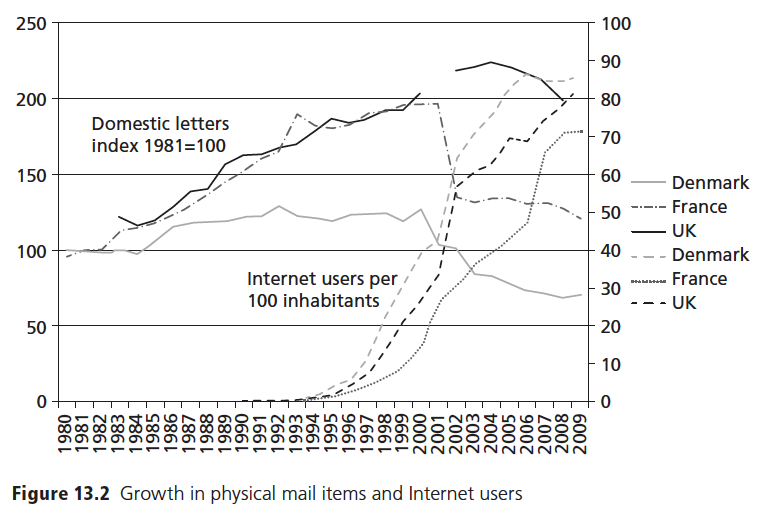
Figure from the book chapter, showing the decline in physical mail volume alongside the rise in internet users.
The Perfect Storm of Disruption
Denmark's decision to end letter delivery didn't happen overnight. Our research on business model innovation in the European postal industry (documented in "The Organizational Dimension of Business Model Exploration" and later summarized in MIT Sloan Management Review) reveals the mounting pressures that postal operators have faced over the past two decades.
The numbers tell a stark story: PostNord's letter volumes plummeted more than 90% since 2000, from 1.4 billion letters to just 110 million in 2024. Meanwhile, parcel delivery—driven by e-commerce—has grown by 17% year-over-year. The business landscape essentially transformed completely, providing tremendous challenges for the postal operator, but at the same time also providing opportunities for exploring new business models as well.
Lessons from the Postal Industry's Transformation
Our research with postal operators in Denmark, Portugal, and Switzerland uncovered critical insights about business model innovation in established organizations:
1. Exploration requires protection and patience. New business models need time to develop without the pressure of immediate profitability. As one postal manager told us, "We quite successfully managed to convince internal management that, for the moment, revenue streams shall not be the most important performance indicator."
2. Organizational tensions are inevitable. New ventures compete with core business for resources, capabilities, and strategic attention. These tensions span cognitive barriers (the "dominant logic" of the existing business), resource struggles, capability substitution, and product cannibalization.
3. Structure follows experimentation, not strategy. Unlike traditional strategic planning where "structure follows strategy," business model exploration requires continuous organizational experimentation. One manager reflected, "We are constantly learning and also modifying the way in which we organize ourselves."
From Endings to New Beginnings
Denmark's postal story isn't one of failure—it's one of adaptation. PostNord is pivoting entirely to parcel delivery, where demand is surging. The classic red mailboxes, sold to collectors for 2,000 Danish kroner each, represent not just nostalgia but a recognition that business models must evolve or become artifacts.
As we stand on the threshold of 2026, there's a powerful metaphor here: just as the New Year brings opportunities to reimagine and renew, every business model that reaches its natural end creates space for something new to emerge.

Figure from the book chapter, illustrating the changing landscape of physical to digital, personal to business, and monopoly to competition.
The Danish postal service's 400-year run is ending, but its infrastructure, brand trust, and customer relationships continue—repurposed for a digital, e-commerce-driven world.
The question for leaders in every industry is not whether their business model will face disruption, but how they'll manage the organizational tensions and experiments needed to discover what comes next.
What business models in your industry are approaching their twilight? And what new opportunities might be emerging?

Marcel Bogers is a Full Professor of Open & Collaborative Innovation at the Eindhoven University of Technology and a Research Fellow at the University of California, Berkeley.
He speaks, writes, and advises on how organizations can create and capture value through openness and collaboration.
Blog posts written with some help of AI! 🙂
Add comment
Comments