Today, January 27, 2026, marks the official publication date of a book that started as something I never quite planned: Social Media for Research Impact: How Scholars Can Share Ideas, Build Networks, and Make a Difference, co-authored with Mike Young and published by Routledge. After more than a year of intensive writing, editing, and refinement—countless hours carved from evenings and weekends, extensive conversations, and the generous support of family who understood when "just one more chapter" became the refrain of our household—we're finally here.
This book represents not just the culmination of our collaborative effort, but also the distillation of more than a decade of my own experiences navigating academic social media, from those early pioneering days when scholars first began experimenting with Twitter at conferences to today's complex multi-platform landscape where researchers must make strategic choices about where and how to invest their digital energy. It's a milestone that feels both deeply personal and hopefully broadly useful, a resource we've designed to serve scholars at every career stage and in every corner of the world, addressing the universal challenges of digital scholarship while remaining sensitive to the diverse contexts in which researchers work. Holding the physical book for the first time on New Year's Eve—watching the year turn as the first box arrived—felt like both an ending and a beginning, the close of one chapter and the opening of another as we now share these insights with the global academic community.

Social media has become pervasive in academic life—and that's both a tremendous opportunity and a significant challenge. Nearly every researcher today faces questions about their digital presence: Should I be on LinkedIn? How do I share my work without feeling like I'm just self-promoting? Is Bluesky (or whatever platform emerges next) worth my limited time? How do I protect myself from the darker sides of online engagement while still reaping the benefits of connection and visibility?
These aren't trivial questions. For many scholars, social media represents uncharted territory where the rules of engagement aren't clear, where the risks feel substantial, and where the return on investment remains uncertain. Yet we also see colleagues building remarkable networks, sparking collaborations that transcend geographical boundaries, reaching audiences far beyond academia, and creating genuine societal impact through their digital presence. The difference between those who struggle with social media and those who thrive often comes down to having a thoughtful strategy and practical frameworks.
That's why Mike and I spent more than a year crafting this book—drawing on our own experiences, interviewing scholars from every continent, synthesizing research on digital scholarship, and developing practical tools that work across disciplines and career stages. We wanted to create something that acknowledges both the bright and dark sides of academic social media, that provides actionable frameworks without prescribing a one-size-fits-all approach, and that speaks to the reality that scholars worldwide face as they navigate an increasingly digital academic landscape.
Where It All Began: A Conference, A Word Cloud, and Unexpected Connections
Back in early 2010s, something remarkable was happening at the Academy of Management conference. Twitter was emerging as a space where academic conversations were spilling beyond conference halls and into a vibrant digital commons. I remember the energy of those early days—watching conversations unfold in real-time, seeing ideas bounce between continents, and experiencing the thrill of serendipitous connections that simply weren't possible before.
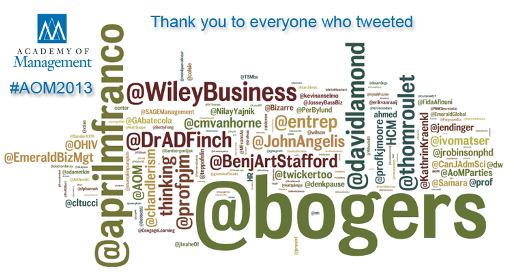
This Twitter word cloud from AOM 2013 captures that moment. It was a time when academics were just beginning to experiment with social media at conferences, and I found myself fascinated by the possibilities. And the remarkable thing is that I had to cancel my AOM attendance at the last minute that year, so Twitter provided me the opportunity to "attend" the conference without even being there! (My hypothesis is that I became the top-Tweeter because I was the only one not actually attending sessions...)
As a postdoc at the University of Southern Denmark, I started doing something quite natural: sharing things I was reading anyway. Retweeting interesting research, commenting on papers, asking questions in public. It didn't take much time, and it felt authentic to who I was as a researcher.
What I didn't expect was how this simple practice would transform my academic life. By consistently sharing and engaging, I became what one colleague aptly described as a "Twitter hub"—a central node in a network where ideas flowed and connections formed. And it was through this role that something particularly significant happened: I connected with Mike Young, who interviewed me for his blog about how my work on Twitter had become intertwined with my research and career.
Looking back, I'd describe my social media journey as a hobby that spiraled into something bigger. What began as casual engagement evolved into a fundamental part of how I approach scholarship, collaboration, and impact. And now, more than a decade later, that experience has culminated in this book.

The Paradox We Address: Fast Media, Slow Impact
Here's something we grapple with right from the start: research operates in one world, and social media operates in another. Academia moves at a deliberate pace—peer review takes months, building a body of work takes years, and meaningful impact often takes decades. Social media, by contrast, thrives on instant gratification, viral moments, and rapid-fire exchanges.
This apparent paradox sits at the heart of our book. But here's the thing: it doesn't have to be a paradox at all. What we've learned—and what we hope to show other scholars—is that you can combine the best of both worlds. You can use fast-paced platforms to share slow-burning ideas. You can leverage social media's reach while maintaining research's rigor. You can build networks quickly that support collaborations unfolding over years.
The key is approaching social media not as a distraction from serious scholarship, but as a boundary-spanning technology that connects research to society, scholars to stakeholders, and ideas to impact.
A Framework for Finding Your Way: The Researcher's Social Media Compass
At the center of our book is something we call the Researcher's Social Media Compass—a framework built around five interconnected elements that help scholars navigate the social media landscape with intention and authenticity.
Purpose sits at the heart of the compass. Why are you using social media? This isn't a rhetorical question. Are you seeking visibility for your work? Building collaborations? Creating societal impact? Your purpose shapes everything else. We guide readers through clarifying their "why," defining specific goals, and aligning their social media presence with both personal and institutional values.

Researcher's Social Media Compass (Figure from Bogers & Young, 2026)
Presence asks you to assess your current digital identity. What shows up when someone googles you? Is your online presence consistent across platforms? Does it accurately reflect who you are as a scholar? We explore how to audit your digital footprint and build credibility through thoughtful profile management.
Platform is about making strategic choices. Different platforms serve different purposes and reach different audiences. LinkedIn isn't Twitter isn't Instagram. We help scholars understand platform cultures and focus their energy where their community actually gathers—because it's far better to do one or two platforms well than many poorly.
Personality addresses something often overlooked: finding your authentic voice. You're not just a publication machine. Balancing professional and personal content, sharing as a person rather than an institution, and developing a genuine presence all contribute to building trust and meaningful engagement.
Practice brings it all together through sustainable routines. This includes everything from scheduling strategies and time boundaries to mindful engagement and ethical sharing practices. Social media doesn't have to consume your life to be effective.
Beyond the Compass: Tools, Tensions, and Transformation
While we've chosen to spotlight the Compass as the book's central framework, we've also developed several other models to support scholars at different stages of their social media journey. These include a comprehensive overview of platform options, a Reflective Model of Scientists' Social Media Use, and frameworks for navigating the inevitable tensions and trade-offs that arise. Because using social media as a scholar is ultimately a balancing act.
We don't shy away from the challenges, either. An entire chapter explores the dark side of social media—what happens when things go sideways, how to handle exposure and vulnerability, strategies for responding to critical comments, and ways to cope with conflict and controversy. These are real issues that scholars face, and we wanted to address them head-on.
But we also dedicate space to the bright side: the generosity, kindness, and community-building that make academic social media such a rewarding space. We explore how to build the community you want to be part of, why kindness matters in online scholarship, and practical ways to be generous in digital spaces. This emphasis on cultivating a kind mindset isn't just feel-good advice—it's strategic for building lasting networks and meaningful impact.
Throughout the book, we also engage with contemporary issues like the role of AI and automation in academic social media. How can scholars leverage these tools ethically while maintaining authenticity? What's the right balance between human connection and machine efficiency? These questions don't have simple answers, but we provide frameworks for thinking them through.
A Global Conversation: Letting the Community Speak
From the beginning, Mike and I knew we wanted this book to have genuinely global reach and relevance. Some aspects of social media are universal—the strength of weak ties, the importance of authentic voice, the need for sustainable routines. But other aspects are more context-specific, shaped by local academic cultures, language considerations, and regional platform preferences.
To address this, we made a deliberate choice: we let the community speak. Throughout the book, we feature voices from scholars literally across all continents—yes, even Antarctica is represented. These aren't just token quotes; they're substantial contributions that address specific themes, share hard-won experiences, and provide widely applicable advice.
This global perspective matters because we genuinely believe this book can help scholars worldwide—from junior researchers just beginning their digital journey to senior academics looking to expand their impact, from university leaders seeking to support their faculty to science communicators bridging research and society.
The endorsements we received reflect this global ambition and community-centered approach. Colleagues from every corner of the world—from Brazil to China, from South Africa to Germany, from Morocco to the United States, from New Zealand to Canada, from Australia to Thailand—have shared how this book addresses needs they see in their own contexts.
Some emphasize the practical roadmap it provides, others highlight its treatment of social media as a tool for real societal impact, and still others appreciate how it helps scholars build confidence in making their ideas visible to the world. What unites these voices is a shared recognition that academic social media, done thoughtfully, can truly help research matter.


The Unboxing Moment: An Ending and a Beginning
On December 31st, 2025, as fireworks exploded outside my home office marking the year's end, the first box of books arrived. I did what felt appropriate for a book about social media: I recorded an unboxing video. Holding that physical copy for the first time—seeing the cover, feeling its weight, flipping through pages that had existed only on screens for so long—was genuinely emotional.

In that moment, I could have said I was "humbled" (a common refrain in academic social media). But as we actually discuss in the book, we should be careful with humble-bragging. The truth is, I'm proud of what we've created. More than that, though, I recognize that while the book's completion marks the end of one journey, it's really the beginning of another. The goal was never just to write a book—it was to help scholars around the world share ideas, build networks, and make a difference.
What You'll Find Inside
The book moves through eleven chapters that take you from understanding why research impact matters in the social media age, through practical strategies for platforms, profiles, and posts, to deeper explorations of curation, productivity, and the integration of AI tools. We examine both challenges and opportunities, provide strategic frameworks for action, and conclude with guidance for navigating an ever-evolving landscape.
You'll find discussions of academic openness and boundary-spanning, explorations of serendipity and the strength of weak ties, practical advice on developing an authentic voice and maintaining a kind mindset, frameworks for reflection and strategy, and honest conversations about building sustainable routines in a world designed for attention capture.
We also connected this work back to earlier contributions that helped shape these ideas—including my 2021 Nature piece on "Five principles for scientists on social media" and research with Ian McCarthy on how scholars actually use these platforms (where we introduce the notion of academic openness) published in 2023 in Business Horizons.
An Invitation
Social media for research impact isn't about gaming algorithms or chasing metrics. It's about connection, conversation, and contribution. It's about finding your people, sharing your passion, and participating in the great collective endeavor of pushing human knowledge forward—with the recognition that today, much of that endeavor happens in digital spaces.
Whether you're a doctoral student wondering if you should even be on social media, a mid-career researcher looking to expand your impact, a senior scholar curious about these platforms, or a university leader seeking to support digital scholarship, we wrote this book for you.
You can learn more about the book on my website, explore it on the Routledge website, or connect with my co-author Mike Young to see how he approaches these ideas. Mike has also created a dedicated book page featuring extra materials, resources, and insights that complement the book's content—definitely worth checking out for additional tools and perspectives on implementing these strategies in your own academic practice.
What began as a hobby that spiraled into something bigger has now become a resource I hope will help countless scholars find their own path in the digital academic landscape. Here's to sharing ideas, building networks, and making a difference—together.
Watch the unboxing video to see the first copies arriving on New Year's Eve 2025.

Marcel Bogers is a Full Professor of Open & Collaborative Innovation at the Eindhoven University of Technology and a Research Fellow at the University of California, Berkeley.
He speaks, writes, and advises on how organizations can create and capture value through openness and collaboration.
Blog posts written with some help of AI! 🙂
Add comment
Comments